📋 Editorial Notice: This article is for informational purposes only. All information is sourced from this platform’s official help center, verified reviews on Trustpilot and BBB, and research from InfoProdSpy, InsightRaider, FinancialBinder, and other verified publications.
📅 Published: August 17, 2026 |
📋 Table of Contents
- What Is Gumroad?
- How Does Gumroad Work?
- Gumroad Interface — What You See Inside
- Who Can Sell on Gumroad?
- Best Niches on Gumroad — What Actually Sells
- Gumroad Pricing & Fees — The Full Breakdown
- How to Set Up a Gumroad Account
- Real Problems People Face on Gumroad
- Is Gumroad Available in Your Country?
- Is Gumroad Worth It in 2026?
- Conclusion
- About the Author
- FAQ
You’ve made something valuable. Maybe it’s an ebook you spent months writing, a set of design templates, a collection of AI prompts, or a course that took you years of experience to put together. Now you want to sell it — without building a full website, hiring a developer, or paying a monthly subscription before you’ve made a single dollar.
That’s exactly the problem this platform was built to solve.
Since 2011, it has become one of the most recognized names in the creator economy — and in 2026, it’s still the platform most people turn to when they want to go from zero to their first sale as quickly as possible. Over $1 billion in total creator sales have been processed on the platform, and creators collectively earned more than $2 million in a single week at the platform’s peak.
But it isn’t perfect, and the internet is full of questions about its fees, payout limitations, account holds, and which niches actually work. This guide answers all of it — based on real data, real user experiences, and the platform’s own official documentation.
What Is Gumroad?
It is an e-commerce platform built specifically for creators who want to sell digital products directly to their audience — without managing a full online store. You sign up, upload your product, set a price, and get a shareable link. That’s it. Someone clicks your link, pays, and receives the file automatically. You get paid.
The platform was founded in 2011 by Sahil Lavingia, who originally built it as a side project. That origin story still shapes how the product feels — it’s optimized for simplicity and for getting creators to their first dollar online, not for enterprise-level commerce operations.
As of 2026, over 19,000 active sellers use this platform, and it supports products in every format imaginable: ebooks, courses, design assets, software, music, 3D files, Notion templates, AI prompt packs, memberships, and physical products shipped by the creator.
What sets this platform apart from Shopify or WooCommerce is the complete absence of a monthly fee. If you make zero sales, you pay zero dollars. It only makes money when you make money — which removes all the financial risk from getting started.
How Does Gumroad Work?
The core flow is simple enough to explain in four steps:
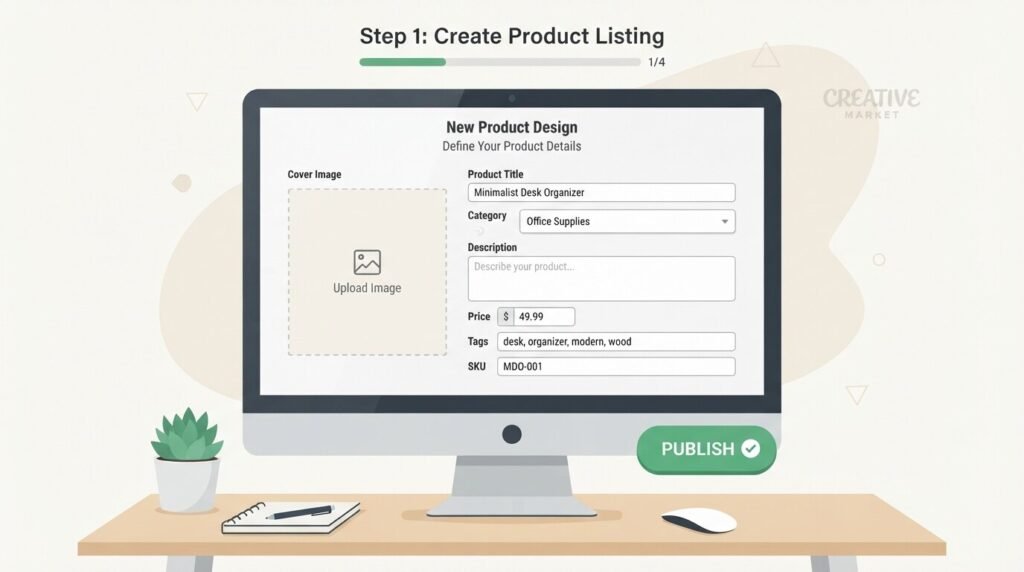
Step 1 — You create a product listing.
Upload your file (or set up a membership), write a description, add a cover image, set your price, and publish. The whole thing takes under 10 minutes for a basic product.
Step 2 — You share your product link.
It gives you a direct link to your product page. Share it anywhere — your social media, newsletter, website, YouTube description, anywhere your audience is.
Step 3 — Your customer buys.
They land on your product page, enter their payment details (credit/debit card, Apple Pay, or bank transfer depending on region), and complete the purchase.
Step 4 — The platform handles everything else.
File delivery is instant and automatic. It sends the buyer a receipt and download link. Since January 2025, it also handles all sales tax, VAT, and GST collection globally on your behalf — acting as what’s called a “Merchant of Record.” This is a significant benefit for creators selling internationally, as it removes tax compliance headaches entirely.
You receive your payout on a weekly basis (Fridays), directly to your bank account or via PayPal in regions where bank payouts aren’t supported.
Gumroad Interface — What You See Inside
One of its genuine strengths is how unintimidating the interface is. If you’ve ever struggled through the setup process of Shopify or WooCommerce, this dashboard will feel almost shockingly simple.
Here’s what you get inside the dashboard:
Products tab
This is where you create, edit, and manage your product listings. Each product has its own page with description, pricing, cover image, and file uploads. You can set fixed prices, offer discounts, or enable “pay what you want” pricing where you set a minimum and buyers can pay more if they choose.
Sales tab
— A clean list of every transaction with buyer email, amount, product, and date. You can issue refunds from here too.
Audience tab
— This platform maintains a list of everyone who has bought from you or followed your profile. You can email them directly from the platform, which is one of its more underrated features.
Analytics tab
— Basic traffic and sales data. You can see where your sales came from, how many page views your products get, and conversion rates. It’s functional but limited — serious sellers usually connect Google Analytics separately.
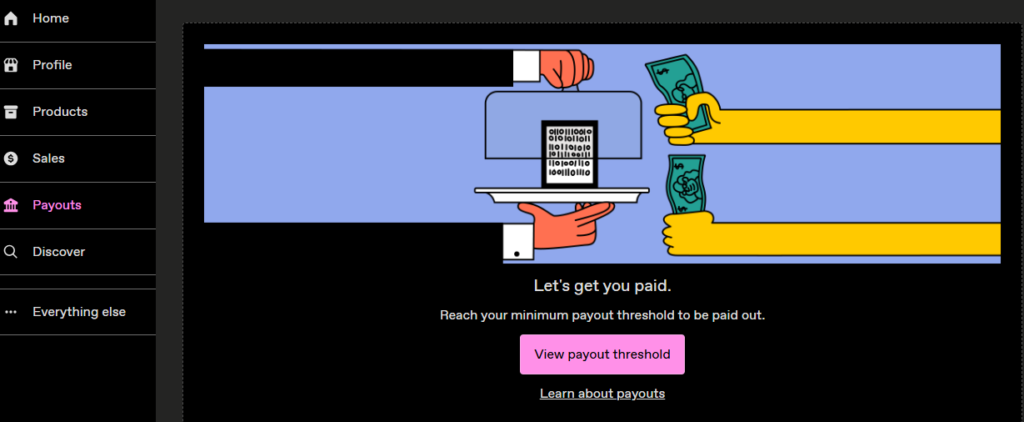
Payouts tab
— Payout history, balance, bank account settings, and tax information.
Discover — A built-in marketplace
where your products can be surfaced to buyers who are browsing looking for things to buy. More on this in the pricing section, because it has a different fee structure.
The interface is genuinely beginner-friendly. You don’t need any coding knowledge, design skills, or technical background. Everything is point-and-click, and its guided setup walks you through the basics when you first sign in.
Who Can Sell on Gumroad?
This is one of its most appealing characteristics — the platform is genuinely open to almost everyone who has something to sell. You don’t need a business registration, a minimum audience size, or prior sales experience.
The types of creators this platform works well for include:
Writers and authors — Ebooks, short stories, guides, research reports, newsletters, and written courses all sell naturally on it. Writing & Publishing has the highest revenue per product of any normal category on the platform ($15,750 per product across just 226 products) — meaning there’s real demand and less competition than in bigger niches.
Designers and visual artists — Logo packs, fonts, UI kits, Procreate brushes, icon sets, Figma templates, Canva templates, and illustration assets are perennial bestsellers. Graphic Design has over 31,400 active products on the platform.
3D artists and game developers — This platform is particularly dominant in the 3D space. Blender assets, ZBrush brushes, VRChat avatars, Unity assets, and Unreal Engine resources all sell heavily. 3D Design is the highest-demand category on the platform based on 2026 data.
Educators and coaches — Online courses, workshop recordings, study guides, templates, and frameworks sell well, especially when tied to a specific professional skill or outcome.
Musicians and audio creators — Sample packs, beats, loops, sound effects, sheet music, and production templates.
Developers and software creators — Code snippets, plugins, scripts, SaaS tools, and browser extensions. Software Development is its highest-revenue category at $65.8 million in total sales, averaging $60,814 per product.
Productivity and business creators — Notion templates, spreadsheet systems, business plan templates, SOPs, and workflow guides are in consistently high demand.
The one honest note: this platform works best for creators who already have an audience or a traffic source — a newsletter, a social media following, a website with SEO traffic, or a YouTube channel. Its internal discovery (the Discover marketplace) drives a minority of revenue for most sellers — typically 10–20%. The platform is a checkout tool, not a marketing machine.
Best Niches on Gumroad — What Actually Sells
Based on analysis of 146,271 active products on the platform in 2026 by InsightRaider and InfoProdSpy, here’s what the data actually shows:
| Niche | Total Revenue | Revenue Per Product | Competition Level |
|---|---|---|---|
| Software Development | $65.8M | $60,814 | High |
| Business & Money | High | Above average | Medium-High |
| 3D Design | High demand (26.8 score) | Strong | Medium |
| Graphic Design | High | Moderate | High |
| Writing & Publishing | Moderate | $15,750 (best ratio) | Low |
| Fitness & Health | Growing | Above average | Medium |
| AI Tools & Prompt Packs | Fast growing | Emerging | Low-Medium |
The best opportunity for new sellers in 2026: Writing & Publishing. It has the highest revenue-per-product ratio of any category on the platform with the least competition. 226 products earn $15,750 each on average — significantly better odds than fighting for visibility in Graphic Design or 3D.
The fastest growing niche: AI tools, prompt packs, and AI-assisted workflows. The highest-earning single product on the platform right now is an AI Photoshop script that has earned $586,000. Demand for AI-enhanced tools is climbing fast across every category.
The best-proven niche for writers: Specific, outcome-driven ebooks dramatically outperform generic information. “Meal prep for busy nurses” converts better than “healthy eating.” “AI skills for real estate agents” sells better than “how to use AI.” Specificity is what commands premium pricing and generates consistent sales.
Gumroad Pricing & Fees — The Full Breakdown
This is the section most people search for first — and it’s also where this platform is most commonly misunderstood.
This platform has no monthly subscription fee. You don’t pay anything to sign up, list products, or maintain your account. Zero upfront cost. This is one of its strongest points for beginners.
Instead, it takes a flat 10% fee on every sale, plus standard payment processing fees:
Platform fee: 10% per transaction Payment processing: ~2.9% + $0.30 (standard Stripe/card processing) Total fees on a $29 sale: approximately $3.54 → you keep roughly $24.46 (84%)
For a $100 product:
It takes: $10 platform + ~$3.20 processing = $13.20 You receive: $86.80
Discover — different fee applies:
If your product is sold through its internal marketplace (where buyers browse and find your product without being sent there by you), it charges 30% instead of 10%. This higher fee covers the cost of them finding the customer for you.
For sales through your own links, profiles, or embeds — the standard 10% applies.
Is the 10% fee high? Compared to other platforms, yes. Stripe charges ~2.9% on its own. Teachable charges 0% on paid plans. But Teachable costs $39–$119 per month. If you’re selling less than $390–$1,190 per month, this no-subscription model is mathematically cheaper. Once you’re scaling past those numbers consistently, it’s worth evaluating alternatives.
Tax handling (the quiet win): Since January 1, 2025, the platform handles VAT, GST, and sales tax globally as your Merchant of Record. For a solo creator selling to buyers in the EU, UK, Australia, and beyond — this eliminates a genuinely painful compliance burden that can cost hundreds of dollars in accounting fees annually.
How to Set Up a Gumroad Account
Setting up an account here is one of the fastest onboarding experiences in the creator economy. Here’s the complete process:
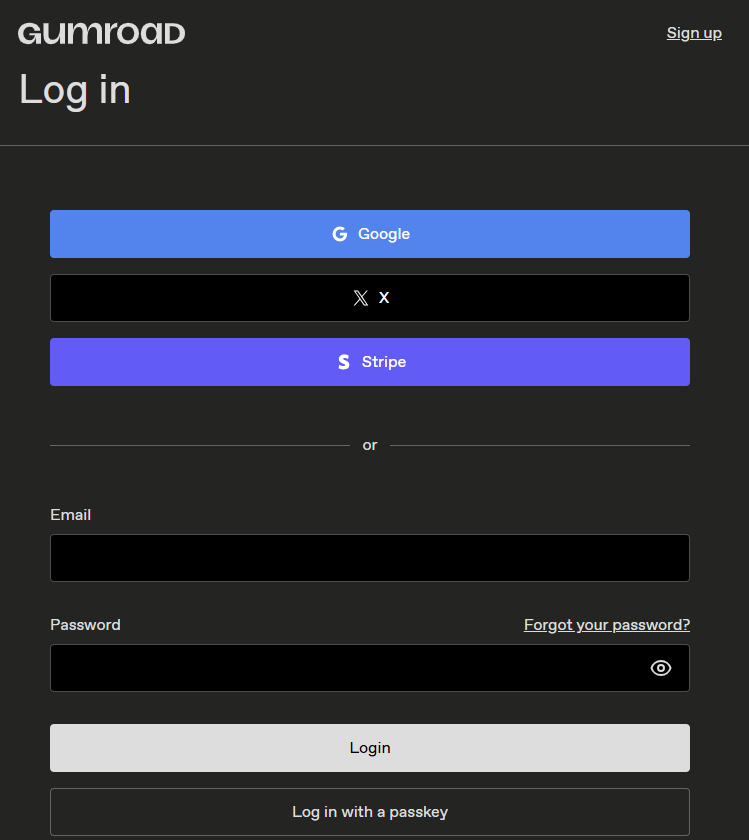
Step 1 — Sign up
Go to gumroad.com → click “Start selling” → enter your email and set a password. Verify via the confirmation email sent to your inbox.
Step 2 — Fill in your profile
Add your creator name, profile photo, and a short bio. Your profile page is where all your products will live, so make it clear and representative of your work.
Step 3 — Set up payouts
Go to Settings → Payments. Connect your bank account (if your country supports direct deposit) or PayPal. This step must be completed before you can publish products. See the country availability section below for important details on where payouts are supported.
Step 4 — Create your first product
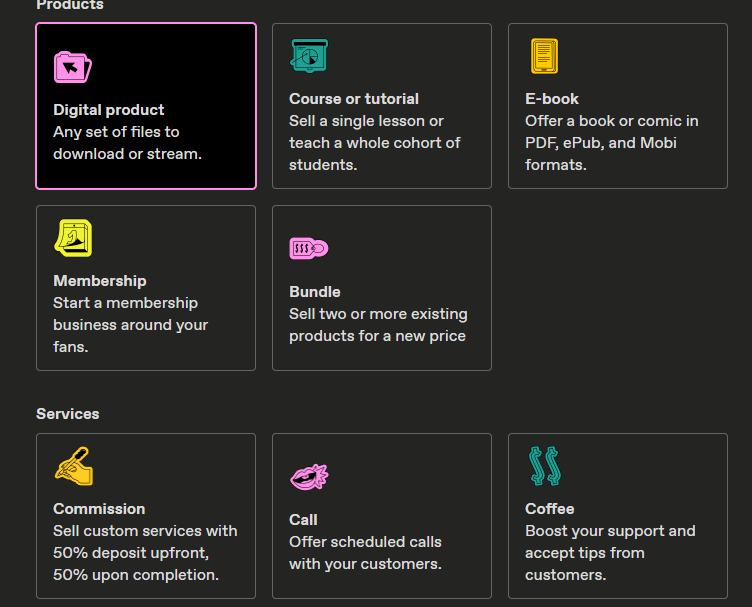
Click “New Product” → choose the type (digital product, membership, physical product, or bundle) → upload your file, write a description, set your price, and add a cover image.
Step 5 — Publish and share
Click “Publish.” It gives you a direct link to your product page. Share it wherever your audience is — social media, email newsletter, YouTube, blog. That’s all it takes to start selling.
Real Problems People Face on Gumroad
This is the section most reviews skip — but it’s the most important one if you’re seriously considering using the platform. These are real, documented issues from verified user complaints on Trustpilot, BBB, and GitHub:
Problem 1: Payout Holds and Risk Reviews
This is the most common complaint across platforms including Trustpilot and BBB. Creators start making sales, hit the minimum payout threshold, and then find their payments flagged for “risk review” — sometimes for weeks or months.
One verified BBB complaint from January 2026: “I made legitimate, non-refunded sales in October 2025, exceeded the minimum sales threshold, and completed all required payout and verification steps. My account shows as verified with no pending items. Despite this, my payouts have been repeatedly marked as skipped due to risk review — it is now January 2026, well beyond the three-week timeframe Gumroad’s documentation states.”
This isn’t rare. Its automated fraud systems are aggressive, and legitimate sellers — especially new ones or those selling high-ticket items — can get caught in holds. If this happens, the recommended approach is to contact support directly with transaction documentation. Avoid repeated verification code requests or reinstalling-style workarounds, which can trigger further flags.
Problem 2: Automatic Refunds Without Creator Consent
Another verified BBB complaint from March 2026: “On March 31, 2026, Gumroad automatically refunded a $733.50 sale to my verified client without my consent. The client purchased my marketing training course, paid with her own card, received the service, and never filed a complaint or chargeback. Gumroad’s automated fraud system flagged and reversed the payment unilaterally.”
Its automated systems can issue refunds when their fraud scoring algorithm flags a transaction as suspicious — even when both buyer and seller report no issue. This is particularly common with high-value transactions or buyers using international cards.
Problem 3: PayPal Is No Longer Available as a Payment Method
In October 2024, PayPal terminated its service agreement with this platform — without advance warning to creators. This had two effects: buyers in many countries can no longer pay with PayPal, and sellers in countries where only PayPal was available for payouts suddenly found themselves unable to receive payments.
It has since expanded bank transfer payouts to more countries, but the PayPal removal remains a significant limitation for creators and buyers in regions where card payments are less common.
Problem 4: Discover Drives Less Traffic Than Advertised
Multiple independent reviews confirm that its internal marketplace (Discover) typically drives 10–20% of a seller’s total revenue — not the majority. Creators who sign up expecting the platform to send them customers are frequently disappointed. The platform is a checkout tool; the marketing is your responsibility.
Problem 5: Copyright Enforcement Is Slow
Trustpilot reviews from March 2026 document cases where creators reported stolen content on the platform three times over 10 days, received AI-generated response emails, and found the infringing products still available. Its copyright enforcement process is criticized for being slow and insufficiently transparent.
Problem 6: Limited Customization for Advanced Sellers
This platform’s storefront customization is basic. You can’t build a multi-page website, add advanced upsell flows, create community features, or run complex discount structures. Sellers who want to scale beyond basic digital product sales often find themselves needing to move to platforms like Teachable, Podia, or Kajabi.
Is Gumroad Available in Your Country?
It supports buyers from almost anywhere in the world — credit and debit card payments work globally.
Seller payouts are more complicated:
Direct bank transfer payout countries — this platform supports local bank payouts in dozens of countries across North America, Europe, Asia, and Latin America. According to its official help center, bank payouts are available to creators who physically reside and can prove residence in the supported country. You cannot receive payouts to a bank account in a country different from your country of residence.
Countries not on the direct deposit list — If your country doesn’t support direct bank transfer, it falls back to PayPal. But since PayPal terminated its relationship with this platform in October 2024, PayPal payout availability varies by region and is not guaranteed.
If neither bank nor PayPal works in your country — According to Gumroad’s own help documentation: “If PayPal doesn’t work in your country, then unfortunately, we have no way to pay you. We don’t have alternate payment methods for people in this situation right now.”
This is a genuine limitation for creators in parts of Africa, the Middle East, and South/Southeast Asia where neither bank transfer nor PayPal is fully supported. Creators in Morocco, for example, have documented issues on its public GitHub repository as recently as January 2026.
Verified countries with bank payout support include the United States, United Kingdom, Canada, Australia, most of the EU, Brazil, India, Japan, Singapore, and many others. The full list is available in Gumroad’s official help center at help.gumroad.com.
💡 Also Read: Looking for another way to earn commissions online? Check out our complete guide to Facebook Affiliate Partnerships — Meta’s native affiliate program that lets creators tag Amazon and Shopee products inside Reels and earn commissions directly.
Is Gumroad Worth It in 2026?
Honest answer: it depends on where you are in your creator journey.
This platform is the right choice if:
You’re just starting out and want to test a product idea with zero upfront cost You already have an audience and need a simple, fast checkout solution You’re selling digital products and want tax compliance handled automatically You want to launch your first product this week, not next month
It is not the right choice if:
You’re in a country where bank payouts aren’t supported and PayPal doesn’t work You’re selling high-ticket services and worried about automated refund reversals You want advanced course features, community tools, or complex funnel structures You’re consistently generating more than $1,000–$2,000/month and the 10% fee is eating significantly into your margins
The platform has processed over $1 billion in creator sales since launch. Creators like Barron van Den Berg scaled to over $2 million in lifetime sales selling Notion templates and productivity guides. Harsh Strongman (LifeMathMoney) crossed $1 million selling self-improvement ebooks to his audience on X. These aren’t outliers — they’re examples of what’s possible when you combine the right product and an existing audience with a checkout tool that gets out of the way.
But they all had audiences first. That’s the honest version of how it works best.
💡 Explore More: Looking for more ways to earn online? Visit our Online Earning section for practical guides on affiliate programs, creator monetization, and digital income strategies.
Conclusion: Gumroad Is the Fastest Way to Sell Your First Digital Product — With Real Limitations to Know About
This platform earns its reputation as the most beginner-friendly option for selling digital products online. No monthly fees, no technical setup, global tax handling, automatic file delivery, and a proven track record of helping creators reach their first sale in under an hour. For someone with something to sell and an audience to sell it to, the platform delivers on its promise.
The limitations are real too — payout holds, aggressive automated fraud systems, the PayPal situation, limited discovery traffic, and weak copyright enforcement are documented problems that affect real sellers. Going in with accurate expectations makes a meaningful difference.
If you’re starting out, it is still the fastest path to your first dollar online. If you’re scaling, it’s worth running the numbers to see whether the 10% fee and platform limitations justify alternatives. And if you’re in a country where payouts aren’t supported, that’s a dealbreaker you need to research before investing time in building a store here.
The platform isn’t perfect. But for what it does — getting creators paid for their work with minimum friction — it remains one of the most effective tools available in 2026.
About the Author
Waqar Ahmad is a tech and digital lifestyle writer with over 6 years of experience covering online earning platforms, creator economy tools, and digital product strategies. Committed to providing honest, research-backed guidance for creators at every level.
Frequently Asked Questions About Gumroad
1. What is Gumroad and what can you sell on it?
This platform is an e-commerce option that lets creators sell digital products directly to their audience without a monthly subscription. You can sell ebooks, online courses, design assets, software, music, 3D files, Notion templates, AI prompt packs, memberships, and physical products. Over 19,000 active sellers use the platform, and it has processed over $1 billion in total creator sales since launching in 2011.
2. How much does Gumroad charge per sale?
It charges a flat 10% platform fee on every sale, plus standard payment processing fees of approximately 2.9% + $0.30 per transaction. There is no monthly subscription fee — you only pay when you make a sale. Sales made through its internal Discover marketplace are charged 30% instead of 10%, because it is finding the customer for you in that case.
3. Which niches sell best on Gumroad in 2026?
Based on analysis of 146,271 active products on the platform, the highest-revenue category is Software Development at $65.8 million total. But the best opportunity for new sellers is Writing & Publishing — it has the highest revenue-per-product ratio ($15,750 per product) with the least competition. AI tools and prompt packs are the fastest-growing niche in 2026. 3D Design and Graphic Design are the highest-volume categories overall.
4. Is Gumroad available in my country for payouts?
It supports local bank payouts in dozens of countries across North America, Europe, Asia, and Latin America. If your country isn’t on the direct deposit list, it falls back to PayPal — but PayPal ended its service agreement with this platform in October 2024, so availability varies. According to Gumroad’s official help center, if neither bank transfer nor PayPal is available in your country, there is currently no alternative payout method. Check Gumroad’s official help center at help.gumroad.com for the current list of supported countries.
5. What are the most common problems on Gumroad?
The most frequently documented issues include: payout holds triggered by automated risk review (sometimes lasting weeks), automatic refunds issued by its fraud systems without creator consent, limited payout options for creators in countries not supported by bank transfer or PayPal, slow copyright enforcement response for stolen content, and Discover driving less traffic than many creators expect (typically 10–20% of total sales). These are documented on Trustpilot, BBB, and its public GitHub repository.