This article is based on verified 2026 social media marketing research and platform data from Buffer, Meta’s official ranking guidance, SocialPilot, Sotrender, and multiple digital marketing agencies tracking algorithm behavior across Instagram, TikTok, and Facebook.
📅 Published: September 17, 2026
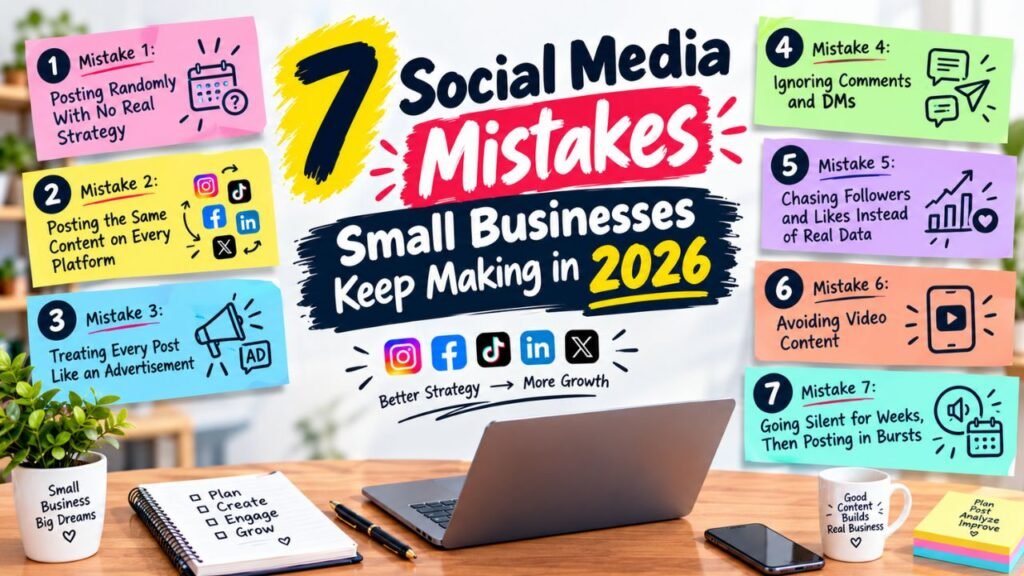
7 Social Media Mistakes Small Businesses Keep Making in 2026

Most small businesses aren’t failing at social media because they’re lazy. They post. They show up. They put real effort into it. And the numbers still don’t move.
The problem usually isn’t effort — it’s a handful of social media mistakes that quietly cancel out everything else a business is doing right. Some of these social media mistakes made sense five years ago and just never got updated. Others are brand new, created by how differently Instagram and TikTok now rank content compared to even two years back. Either way, they’re costing small businesses reach they’d otherwise be getting for free.
Here are the 7 social media mistakes that show up most often, why they actually hurt you, and what to do instead. Fixing even a few of these social media mistakes tends to move the needle faster than most owners expect.
Table of Contents
- Mistake 1: Posting Randomly With No Real Strategy
- Mistake 2: Posting the Same Content on Every Platform
- Mistake 3: Treating Every Post Like an Advertisement
- Mistake 4: Ignoring Comments and DMs
- Mistake 5: Chasing Followers and Likes Instead of Real Data
- Mistake 6: Avoiding Video Content
- Mistake 7: Going Silent for Weeks, Then Posting in Bursts
- Quick Reference: Social Media Mistakes and Their Fixes
- Conclusion: Fixing These Social Media Mistakes Doesn’t Take a Budget
- FAQs
- Sources
Mistake 1: Posting Randomly With No Real Strategy
This is one of the most common social media mistakes small businesses make, and it’s often the root cause behind several others on this list. A lot of small business accounts post whenever there’s time — a product photo one week, nothing for ten days, then three posts in one afternoon because someone remembered the account exists. There’s no real goal behind any single post beyond “we should probably post something.”
This confuses actual people and it confuses the algorithm. Every platform now tries to figure out what an account is about so it can match content to the right audience. An account that jumps between topics and formats with no pattern gives the algorithm nothing consistent to work with, which makes it harder for any single post to find its audience.
The fix: Before posting anything, know what that specific post is supposed to do — get saves, start a conversation, drive a click, build trust. A simple weekly content plan, even just five bullet points in a notes app, fixes most of this.
Mistake 2: Posting the Same Content on Every Platform
Another social media mistake that looks efficient but isn’t: cross-posting the exact same caption and video to Instagram, TikTok, Facebook, and LinkedIn. Each platform ranks content differently and rewards different things — TikTok favors longer watch-through and re-watchability, Instagram now weighs DM shares and saves heavily, and LinkedIn rewards a completely different tone and format than either.
Content built for one platform and dropped unchanged into another usually underperforms everywhere at once, because it’s not actually optimized for any of them.
The fix: Reuse the core idea, not the exact file. A 60-second TikTok might become a carousel on Instagram and a short text post with one image on LinkedIn — same message, format adjusted per platform.
Mistake 3: Treating Every Post Like an Advertisement
Another of the most damaging social media mistakes is turning every post into a pitch. When almost every post is “buy this,” “book now,” or “limited time offer,” people stop paying attention fast. Audiences can tell within a few posts whether an account is trying to build something worth following or just trying to sell to them.
This matters more than it used to, because platforms are increasingly ranking content based on whether people engage with it — commenting, saving, sending it to a friend. Pure sales posts rarely generate any of that.
The fix: A commonly used ratio is roughly 80% content that helps, entertains, or informs, and 20% that actually promotes something. Behind-the-scenes posts, quick tips, and customer stories all count toward the 80%.
Read Our Complete Article About Facebook Monetization Tools
Mistake 4: Ignoring Comments and DMs
This social media mistake is easy to miss because it’s about what a business isn’t doing rather than what it is. A business that posts consistently but never replies to comments or messages is leaving one of the strongest ranking signals on the table. When someone privately shares a post or sends a message about it, several platforms now treat that as a stronger sign of value than a like — and a business that doesn’t respond misses the chance to turn that interest into an actual customer.
It also just reads as impersonal, and it’s one of the social media mistakes people notice fastest — customers can tell when a brand account clearly isn’t listening.
The fix: Set aside 10–15 minutes after each post to reply to comments and messages. It doesn’t need to be instant, just consistent — same-day replies are enough to keep the conversation (and the algorithm signal) alive.
Mistake 5: Chasing Followers and Likes Instead of Real Data
Of all the social media mistakes on this list, this one is the hardest to notice because it feels productive. Follower count and likes are the easiest numbers to check, so they get treated as the scoreboard. They’re also the least useful ones. A business can have a large following that never buys anything, or a small one that converts consistently — the follower count alone tells you nothing about which one you have.
Saves, shares, click-through rate, and DM replies are far better indicators of whether content is actually working, and they’re the same signals Meta’s own ranking guidance confirms platforms now use internally to decide who sees a post next.
The fix: Check platform analytics monthly and track saves, shares, and profile visits — not just followers gained. If a post gets shared a lot but has modest likes, that post is working harder than the numbers suggest.
Mistake 6: Avoiding Video Content
This is one of the more understandable social media mistakes, since video genuinely feels more time-consuming or intimidating to make. Plenty of small businesses still lean almost entirely on static photos. Static content isn’t dead, but on most platforms it now competes directly against video for the same space in someone’s feed — and video, especially short-form, consistently pulls more watch time and reach.
You don’t need studio-quality production. A steady phone camera, decent lighting, and a clear opening line matter far more than expensive equipment.
The fix: Start with something low-pressure — a 30-second product demo, a quick tip, or a behind-the-scenes clip. Consistency in showing up on video matters more than polish.
Mistake 7: Going Silent for Weeks, Then Posting in Bursts
Of all seven social media mistakes covered here, this is the one with the clearest data behind it. Buffer’s 2026 State of Social Media Engagement report, based on an analysis of roughly 52 million posts, found that accounts going silent for even one week take a measurable reach penalty afterward — and recovery isn’t instant. Smaller accounts (under 10,000 followers) typically need two to six weeks to recover lost reach, while larger accounts can take four to twelve weeks.
The instinct to disappear during busy periods and then “make up for it” with a burst of posts actually makes the recovery slower, not faster, since the algorithm has to relearn the account’s activity pattern from scratch.
The fix: A lighter, sustainable schedule beats an ambitious one you can’t maintain. Posting three times a week, every week, consistently outperforms posting daily for a month and then vanishing for six weeks.
Quick Reference: Social Media Mistakes and Their Fixes
Here’s a fast-scan summary of all seven social media mistakes and the fix for each one:
| Mistake | Quick Fix |
|---|---|
| Posting randomly | Plan each post’s purpose in advance |
| Same content everywhere | Adapt format per platform |
| Every post is an ad | Follow an 80/20 value-to-promo ratio |
| Ignoring comments/DMs | Reply within the same day |
| Chasing likes/followers | Track saves, shares, and click-through rate |
| Avoiding video | Start with short, low-effort clips |
| Posting in bursts | Keep a lighter, consistent weekly schedule |
Conclusion: Fixing These Social Media Mistakes Doesn’t Take a Budget
None of these seven social media mistakes require a bigger budget or a marketing agency to fix — they’re mostly habits, not resources. Most small businesses already have decent products, real customer stories, and enough content ideas sitting in their phone’s camera roll. What’s usually missing is a consistent, platform-aware approach instead of sporadic, one-size-fits-all posting.
Fix even two or three of these, and the difference in reach and engagement tends to show up within a few weeks — not because the algorithm suddenly favors you, but because you finally started giving it something consistent to work with.
💡 Also Read: Struggling to find time to fix all this on top of running your business? Here’s where to start: 7 AI Tools That Actually Save Small Business Owners Time
About the Author
Waqar Ahmad is a tech and digital lifestyle writer with over 6 years of experience covering social media platforms, AI tools, and the online earning space. He writes to make marketing and tech trends practical for small business owners and everyday readers.
Frequently Asked Questions
1. What is the biggest social media mistake small businesses make?
Among all the social media mistakes small businesses make, posting without a clear strategy or purpose is the most common. It leads to inconsistent content that confuses both the audience and the platform’s algorithm, making it harder for any single post to reach people.
2. How often should a small business post on social media?
Three to five times a week on the main platform is a realistic, sustainable pace for most small businesses. Going quiet for weeks and then posting in bursts is one of the social media mistakes that hurts reach the most — a lighter but consistent schedule performs better long-term.
3. Do likes and followers still matter for growth?
They still matter, but chasing them instead of real engagement data is one of the more common social media mistakes small businesses fall into. Saves, shares, comments, and DM replies are now stronger signals to most platform algorithms and are better indicators of whether content is actually connecting with an audience.
4. Is it bad to post the same content on every social media platform?
It’s not harmful, but it’s one of the social media mistakes that quietly wastes effort. Each platform ranks and rewards content differently, so content built specifically for one platform and reused unchanged elsewhere usually underperforms compared to content adapted to each platform’s format and audience.
5. What happens if a business stops posting for a few weeks?
This is one of the costliest social media mistakes on this list. According to 2026 Buffer research, accounts that go silent for even one week see a measurable drop in reach afterward. Smaller accounts typically take two to six weeks to recover, while larger accounts can take four to twelve weeks.
6. Do small businesses need professional video equipment for social media?
No, and assuming otherwise is one of the social media mistakes that stops businesses from starting at all. A steady phone camera, decent lighting, and a clear opening few seconds matter far more than expensive equipment. Consistency in posting video content matters more than production quality.
Sources
- Buffer — 2026 State of Social Media Engagement report (52 million posts analyzed)
- SocialPilot — Social media algorithm updates, 2026
- Sotrender — Social media algorithm changes in 2026
- Meta’s official ranking guidance for Instagram
- Multiple 2026 small business marketing case studies and agency reports
Pingback: 7 AI Tools That Actually Save Small Business Owners Time